
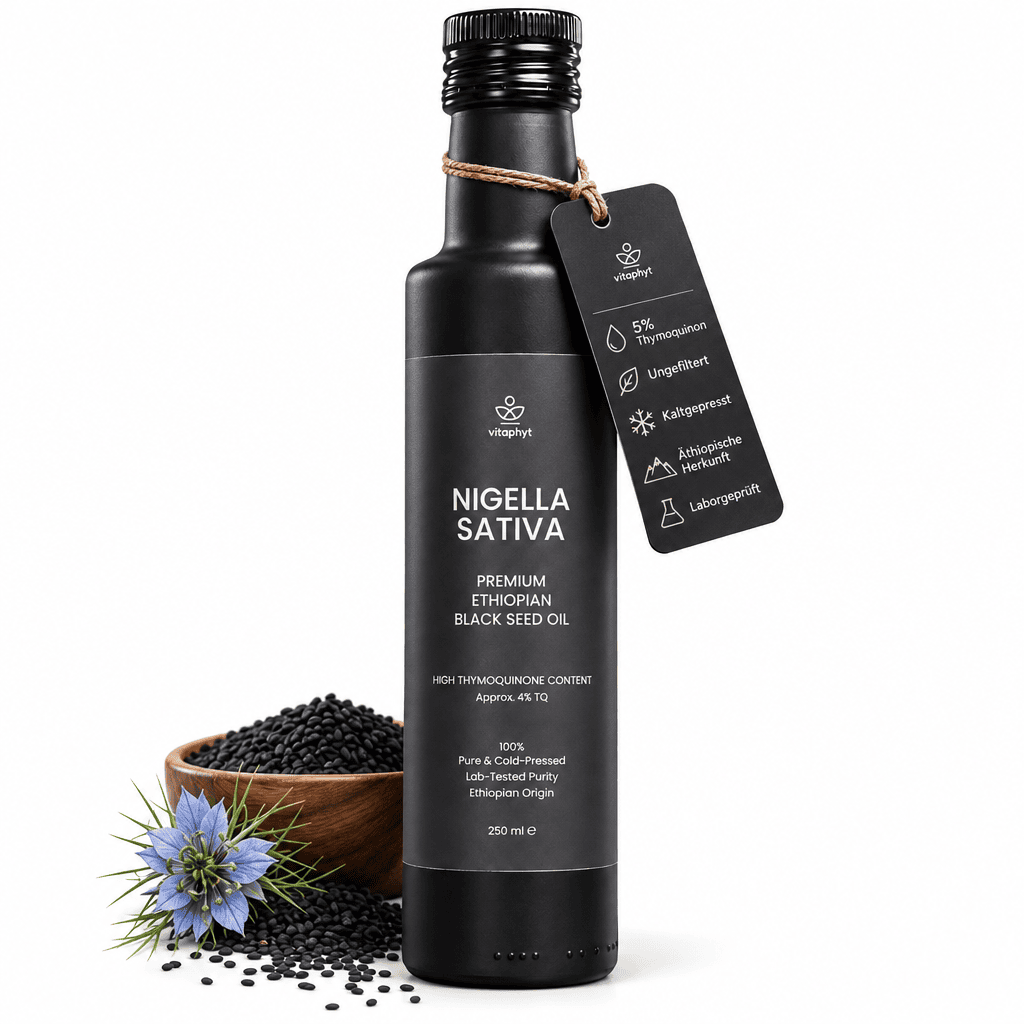
vitaphyt Ethiopian black seed oil
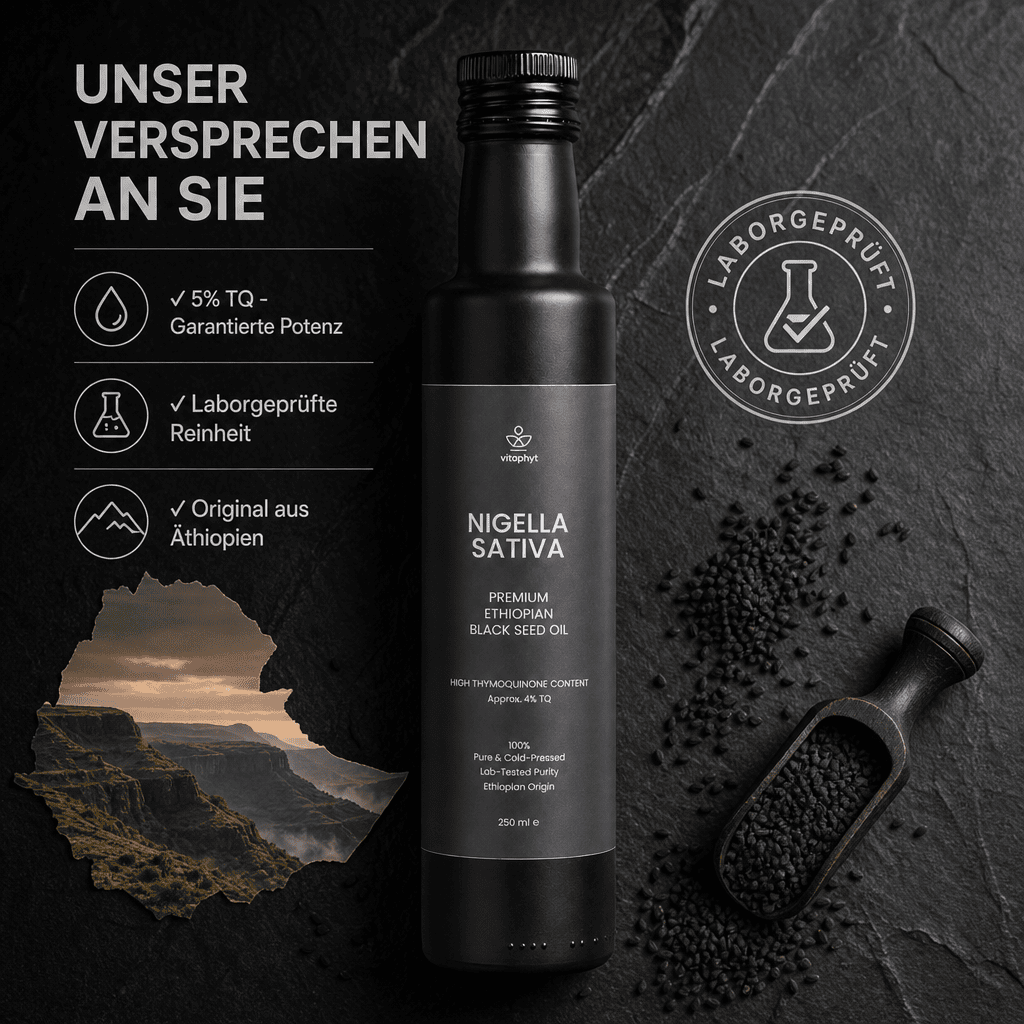
Grown on our own fields near Gondar. Cold-pressed in Ethiopia.
Free delivery (DE)
You save 9,99€
Free delivery (DE)
You save 24,98€


Product details
| Contents | 250 ml |
|---|---|
| Ingredients | 100% pure black seed oil (Nigella sativa) |
| Note | From Ethiopian seed, cold-pressed, bottled in Germany. High thymoquinone content (approx. 4% TQ). |
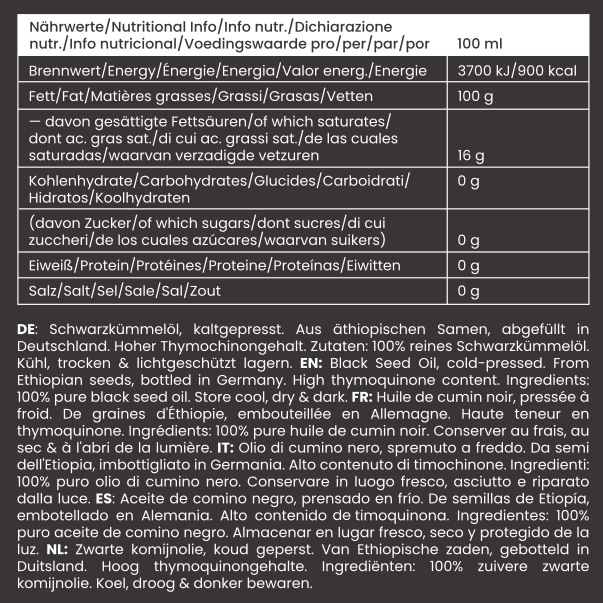
| Nutrition declaration | per 100 ml |
| Energy | 3700 kJ / 900 kcal |
| Fat | 100 g |
| – of which saturates | 16 g |
| Carbohydrate | 0 g |
| – of which sugars | 0 g |
| Protein | 0 g |
| Salt | 0 g |
| Storage | Store in a cool, dry place away from light. |
| Package size | 1x 250 ml, 2x 250 ml, 3x 250 ml |
Why origin and processing matter
Altitude and proximity to the equator shape Ethiopian black seed.
1,800–3,000 m equatorial sun
Altitude and proximity to the equator bring strong sun, cool nights and slow ripening.
Volcanic highland soils around Gondar
Slow ripening, crop rotation and cool highland nights shape the size and aroma of the seed.
Cold-pressed locally
Pressed near Gondar, mechanically and at no more than 35 °C. Bottled in Germany, in light-proof glass.
How to recognise good black seed oil
Origin, pressing and bottle determine quality. Here is what matters:
- Check the unit: the bigger number is not what counts. 1% equals 10,000 mg/kg, or 10 mg/g. The same amount, just written differently.
- Hot pressing & refining: heat can impair the aroma and delicate compounds.
- Clear glass & plastic: light makes delicate oils age faster.
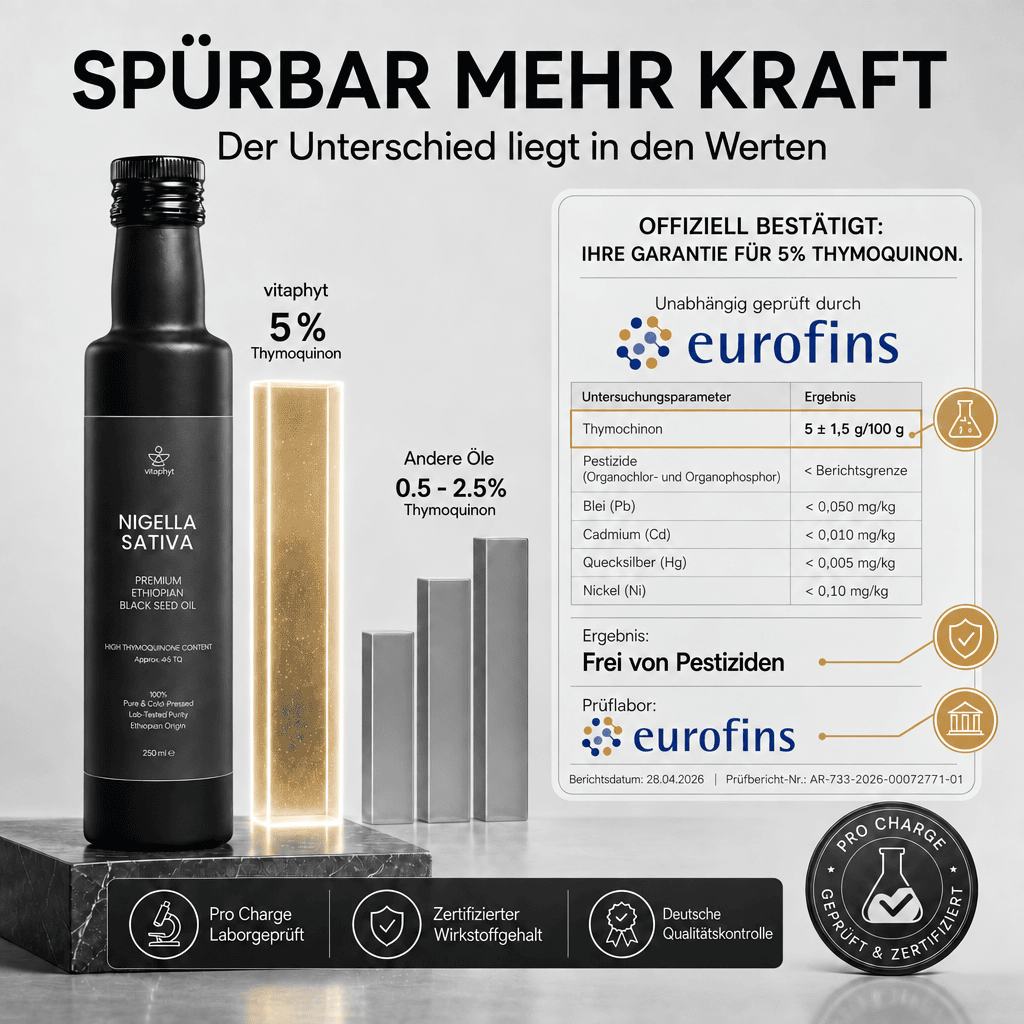
- Up to 5% thymoquinone: measured in the pure oil by Eurofins.
- Cold-pressed at max. 35 °C: mechanically pressed, bottled unfiltered.
- Black UV glass: keeps out UV radiation and daylight.
Our family in Gondar
One family, one place, one chain: from the highland harvest to the bottle in your hand.

Our family farms fields near Gondar, at 1,800 to 3,000 m. What grows there, we gently cold-press on site. Only then does the oil travel to Germany for bottling.
The seed goes into the press without pre-heating, at no more than 35 °C. The oil was tested by Eurofins, accredited to ISO 17025.
Thymoquinone, the main component of the essential oil, reaches up to 5% in our oil, depending on the harvest. Eurofins measured it in the oil itself, not in the seed.
With us, this whole chain is in one pair of hands. So our origin is not a claim, but our own family history.
Ethiopia · Gondar · 1,800–3,000 m
Family-run since the 1960s
Cold-pressed · unfiltered · lab-tested
How to use the oil
Shake briefly before use so that the natural sediment is distributed. Three habits that make room for it every day.
Enjoy it neat
Neat from the spoon: bold, peppery and unadulterated.
Stirred into honey
Mixed with honey or a little lemon juice, the heat becomes milder: a good start.
A finishing drizzle
A peppery finish over salad, vegetable soup or hummus. Do not heat it, or the essential oils lose their aroma.
From our customers' kitchens
Feedback by email and Instagram.
“Three weeks in my morning routine, and the spoon now sits next to my coffee. The heat is real, but that is exactly how it should be.”
Miriam K.“The finish over hummus and lentils: guests ask about it every time. Peppery, but the good kind.”
Jonas B.“A spoonful over tomatoes, cucumber and parsley, with flatbread for dipping. Bold, slightly bitter. The bottle now sits next to the salt.”
Aylin S.Scientific sources
More than 1,200 studies in the PubMed database deal with black seed oil and thymoquinone.
More thymoquinone at higher altitudes
Gebremedin et al. (2024): Biochemical Characterization of Ethiopian Black Cumin (Nigella sativa L.). International Journal of Food Science, Article 2746560. DOI: 10.1155/2024/2746560
Black seed oil in the scientific literature
Stolzenburg, M. (2019). Bachelor's thesis, HAW Hamburg.
Studies on black seed oil at a glance
Chrubasik-Hausmann, S. (2021). University Medical Centre Freiburg.
vitaphyt vs. conventional black seed oil
Purity, thymoquinone content, light protection: a direct comparison.
Black seed oil FAQ
Origin, use and quality, answered briefly.